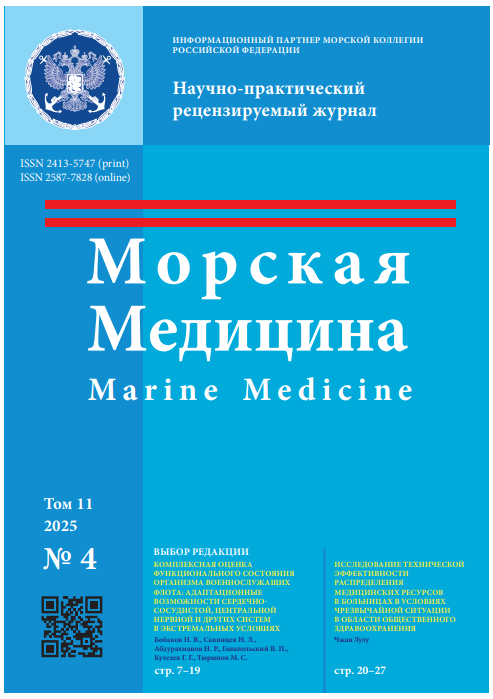
The scientific and practical peer-reviewed journal “Maritime Medicine” (hereinafter referred to as the Journal) is a special publication on the impact of the Ocean on human health and the preservation of human potential in maritime industries and coastal areas.
The journal is positioned as an interdisciplinary publication of a scientific-theoretical and scientific-practical nature, accepting for publication in Russian and English the results of fundamental and applied scientific research, scientific reviews, original articles, lectures, clinical cases, reports, and reviews on topical issues in maritime medicine.
The target audience of the journal includes employees of scientific departments and centers of the Russian Academy of Sciences, foreign academies of sciences and scientific communities, and medical associations; scientific research organizations and departments; faculty members, graduate students, and employees of higher and secondary vocational education institutions; medical, pharmaceutical, and public organizations in Russia and abroad; leaders and experts from relevant federal executive bodies, executive bodies in coastal regions, leaders and specialists from shipbuilding and ship repair enterprises, design bureaus, shipping companies, health care management bodies of various departments, ship and naval doctors, flagship doctors, specialists in diving and aviation medicine, experts engaged in researching the impact of the marine climate on human health.
Publication objective: communicating information about promising scientific (medical, pharmaceutical, physiological and hygienic, psychophysiological, engineering and psychological, and ergonomic) research on the impact of the Ocean on human health, the preservation of human potential in maritime industries, and the health of coastal populations, as well as scientific development in the field of life support, efficiency, reliability, preservation of professional health, and extension of professional suitability of ship (marine) specialists, divers, and other subjects of maritime activity.
For more details on the Journal's topics, see the “Goals and Objectives” section.
The journal is included in the List of Russian peer-reviewed scientific journals of the Higher Attestation Commission of the Ministry of Education and Science of the Russian Federation for the publication of the main scientific results of dissertations (К2).
The journal cooperates with Crossref, the official agency for registering digital object identifiers (DOI) of the international DOI Foundation, which brings together publishers of academic publications (journals, monographs, conference proceedings). Each publication in the journal is assigned a digital identification number (DOI).
The journal pursues an open access policy (Open Access), providing free, prompt, permanent, full-text online access to scientific publications.
The journal uses an automated anti-plagiarism system that checks the text for similarities with previously published materials in order to determine the uniqueness of the text and identify possible instances of plagiarism.
Indexation: HAC (K2), RINC (Science Index), RSEB Elibrary.ru, Russian State Library, Abstract Journal and Database of the All-Russian Institute of Scientific and Technical Information (ARISTI) of the Russian Academy of Sciences, RSEB “Cyber Leninka”, Ulrich's Periodicals Directory international reference system for periodicals and continuing publications, Google Academy (Google Scholar), Dimensions scientific information platform, GlobalHealth database, Chinese technology company Baidu, CABI system, EBSCO, the CNKI Scholar platform, the Research4life platform, the Internet ARCHIVE scholar scientific search engine, the open network scientific archive Socionet, the social network for doctors Vrachy RF, the national digital resource, the interdisciplinary scientific library Rukont, the free program for managing bibliographic information Mendeley, Wikidata knowledge base, OS (operating system), MIT Libraries academic library system, The Lens patent and scientific literature database, Unpaywall browser extension, The University of California, Berkeley, World Cat database, “Press by Subscription” from the agencies “Book Service” and “ARZI” (Agency for the Distribution of Foreign Publications)
Key facts about the Journal
Frequency: 4 issues per year (quarterly).
Number of articles per issue: 12-15.
Issue volume: 15-20 printed sheets.
Languages: Russian, English.
Geographical diversity of editors: from 23 cities, from 10 countries.
Top countries in terms of readership: Russia, China, Netherlands, Turkey, Kazakhstan, Belarus, Montenegro, Turkmenistan, France, Indonesia, USA, Vietnam, Mexico.
Top cities in Russia in terms of readership: Kaliningrad, Moscow, Saint Petersburg, Ulyanovsk, Smolensk, Nizhny Novgorod, Taganrog, Arkhangelsk, Saratov, Tyumen, Tomsk, Tula, Republic of Crimea, Tambov, Yelets, Krasnodar, Yekaterinburg, Vologda, Vladivostok, Murmansk, Makhachkala, Samara.
Percentage of manuscripts accepted: 90%.
Average time from submission to publication of a manuscript: 64 days.
Official website: https://seamed.elpub.ru/
Current issue
Review
INTRODUCTION. Despite modern achievements in cellular and molecular immunology, the immunopathogenesis of parasitic infestations remains an insufficiently studied problem of infectious pathology.
OBJECTIVE. To analyze the immunopathogenesis of parasitic infestations and modern methods of their diagnosis.
MATERIALS AND METHODS. The study is based on an analysis of 48 scientific medical publications from 1982 to 2024 in international and Russian scientific literature databases Google Scholar, PubMed, eLIBRARY, and Scopus using keywords and their combinations in Russian and English: antibodies, antigens, immunopathogenesis, the immune system, variability of parasitic antigens.
RESULTS. It has been established that the variability of parasite antigen structures and their life cycle contribute to immune suppression and evasion of immunological surveillance. Depending on their nature, parasites utilize both extracellular and intracellular parasitization modes, so T-helper cells of types 1 and 2 participate in the development of the adaptive immune response. Among cellular factors, phagocytes, including eosinophils, are of the greatest importance. The effectiveness of parasite elimination from the host largely depends on the interferon system, primarily interferons γ and δ. Microscopic, immunological, and molecular genetic techniques are used in the diagnosis of parasitic infestations.
DISCUSSION. Most parasites have a complex life cycle, occurring in different hosts with alternating antigen structures. The effectiveness of pathogen neutralization and subsequent elimination largely depends on the state of the innate and adaptive immune systems. Most parasitic infestations result in immediate and delayed hypersensitivity reactions. These are often accompanied by autoimmune reactions, which complicates immunopathogenesis and diagnosis.
CONCLUSION. Parasitic infestations are most often chronic and persistent, which affects the characteristics of immunopathogenesis and etiological diagnosis. The parasites’ multi-stage life cycle, antigen camouflage, mimicry, diversion, and variability allow them to evade immune system control. Microscopic, serological, and molecular techniques are used in the diagnosis of parasitic infestations.
INTRODUCTION. The article presents the results of numerous studies, including foreign ones, devoted to the study of the role of vitamin D in functioning various organs and systems, the provision of physiological processes, and the occurrence of pathological changes in its deficiency. Given the fact that vitamin D is produced by exposure to sunlight, the deficiency of which is experienced by the personnel of submarine and surface vessel crews, the significance of these studies is important for practical application in maritime medicine.
OBJECTIVE. To summarize the data on the role of vitamin D in functioning human body systems, to analyze the presented multicenter studies of the effect of vitamin D deficiency on the occurrence of various diseases and to suggest some preventive measures aimed at compensating when detected.
MATERIALS AND METHODS. The article reviewed materials of scientific studies devoted to the study of the role of vitamin D in the metabolism of the human body, and gave recommendations, including clinical, on the detection of vitamin D deficiency in adults. The search and analysis of the scientific medical literature was carried out for the period from 2004 to 2025. in databases: scientific electronic library eLibrary.ru, Russian National Library, Fundamental Library of the Military Medical Academy. S. M. Kirova, electronic search engine PubMed. A total of more than 70 publications were analyzed. Keyword queries were: vitamin D deficiency, cholecalciferol, effect of vitamin D on the human body.
RESULTS. The analysis of literature sources showed that vitamin D plays an essential role not only in phosphorus-calcium metabolism and skeletal formation, but also in metabolic processes, immunity, and both directly and mediatedly through the mentioned links of pathogenesis related to impaired metabolism and immune response overall somatic morbidity.
DISCUSSION. The data obtained as a result of an analytical review of the scientific literature confirm the need to control the blood content of vitamin D levels in specialists of the Navy of the Russian Federation (Navy). When its deficiency is identified, it is necessary to adjust the daily intake of foods that are a source of vitamin D. It is advisable to recommend physical procedures that stimulate the production of vitamin D under artificial ultraviolet exposure. In addition, on an individual basis, periodic use in the daily diet of approved food biologically active supplements containing a source of vitamin D and calcium is possible.
CONCLUSION. Understanding the comprehensive effects of vitamin D on the body is necessary for the prevention of its deficiency in surface ship and submarine crews, which aims to reduce the risk of developing general somatic pathology, reduce morbidity and promote the performance of specialists.
Original articles
INTRODUCTION. In fulfilling missions assigned by the military-political leadership, the Russian Armed Forces are increasingly faced with the need to promptly respond to humanitarian crises and participate in humanitarian operations. This article substantiates the choice of a medical support model for a humanitarian operation in West Darfur Province (Sudan) as a testing ground for stochastic simulation modeling. It is shown that Russia’s strategic interest in the Red Sea region and the Horn of Africa, enshrined in the National Security Strategy and Foreign Policy Concept, makes the participation of the Russian military medical contingent in such operations a relevant practical objective.
OBJECTIVE. To provide a comparative assessment of the efficacy of medical support for a group of forces in a humanitarian operation at an average (p_block = 0.20) and high (p_block = 0.35) risk level using the method of stochastic simulation modeling using the example of a humanitarian operation in the province of West Darfur (Sudan).
MATERIALS AND METHODS. A simulation model (100 runs per scenario) was developed, including modules for logistics, hospital bed capacity, evacuation, and epidemiological status. The testing site is West Darfur Province (Sudan). The planned number of beneficiaries is 560,000 people. The estimated bed requirement is based on the SPHERE standard (1 bed per 400 people for 90 days).
RESULTS. At the medium risk level, the standard coverage of the population with medical care was 73.2 ± 4.7% (resistance 81%), bed occupancy was 30.6%, and compliance with the “golden hour” was 94.6%. At the high risk level, the coverage parameter decreased to 37.4 ± 4.6% (no run reached the threshold of 70%, resistance 0%), bed occupancy increased to 90.3%, and hospital overload was observed in 48% of runs. The Pearson correlation coefficient between the number of days with blockages and coverage was r = –0.82 (p < 0.001), between delivery delays and coverage — r = –0,85 (p < 0,001).
DISCUSSION. The findings are consistent with the literature on the key role of logistics and medical support in humanitarian operations. At high risk, the sustainability of the humanitarian operation is reduced to zero, and the occupancy of beds exceeds standard values by almost three times. It has been determined that the main destabilizing factors of a humanitarian operation are blocking routes, low stocks of medicines and medical products, no restrictions on evacuation capacity, and a linear approximation of the dependence of delays on blockings.
CONCLUSION. The transition to a high risk level (p_block = 0.35) catastrophically reduces the effectiveness of medical care. Achieving acceptable population coverage through medical care under such conditions requires increasing hospital beds by 2-2.5 times, creating three-month reserves of medications and medical supplies, and utilizing air ambulance services.
OBJECTIVE. The study aims to evaluate progression-free survival (PFS) and objective response rate (ORR) when using fulvestrant with alpelisib in a group of patients with luminal PIK3CA+/ HER2- mBC who previously received fulvestrant.
MATERIALS AND METHODS. We retrospectively assessed the treatment outcomes of 45 patients with PIK3CA-mutated HR+HER2- mBC who received alpelisib in combination with fulvestrant after progression on fulvestrant in one of the previous lines of therapy at the State Budgetary Healthcare Institution “Saint Petersburg Clinical Scientific and Practical Center for Specialized Types of Medical Care (Oncologycal) named after N. P. Napalkov” from January 1, 2021, to January 1, 2025.
RESULTS. The analysis included 45 patients who received alpelisib with fulvestrant from January 1, 2021, to January 1, 2025: 22.2 % (n = 10) in the second line, 46.7 % (n = 21) in the third line, 24.4 % (n = 11) in the fourth line, and 6.7 % (n = 3) in the fifth line of therapy. Chemotherapy for mBC had been previously administered to 26.7 % (n = 12) of the patients. A dose reduction of alpelisib was recorded in 46.7 % (n = 21) of patients, and one patient discontinued therapy due to toxicity. The median follow-up for the entire cohort was 10 months (IQR 5–12). A partial response, assessed by RECIST 1.1 criteria, was observed in 6.7 % (n = 3) of patients, and stabilization was noted in 42.2 % (n = 19). The median progression-free survival was 5.0 months ± 0.75 (95 %; CI: 3.56–6.44). Additionally, a response to therapy lasting more than 12 months was recorded in 11.1 % (n = 5) of study participants.
CONCLUSIONS. The use of fulvestrant with alpelisib in patients with PIK3CA-mutated HR+/HER2- mBC who received fulvestrant in previous lines showed clinical benefit. Among the significant limitations of our study is the small sample size of patients.
INTRODUCTION. An important national objective of the Russian Federation is the development of the Arctic zone, which determines the relevance of the problem of organizing the provision of emergency medical care to victims of emergency situations and the seriously ill, including their medical evacuation. OBJECTIVE. Analysis and generalization of the experience of testing new domestic medical devices and thermal protective equipment within the framework of the interdepartmental experimental research drill “Safe Arctic 2025” in the Arctic zone of Russia.
MATERIALS AND METHODS. During the Safe Arctic 2025 interdepartmental research and development drill, while training aeromedical evacuation of victims from a vessel in distress, new domestic medical products (an aviation medical module, a prototype in Arctic design; devices for transporting extracorporeal membrane oxygenation) were tested, as well as thermal protective equipment for medical personnel (thermal gloves), the victim (thermal blanket), and medical equipment (thermal protective cases, thermal protective equipment for IVs). The Mi-8AMTShA-VA helicopter in Arctic design, equipped with a standard helicopter medical module, was used to organize the work of the aeromedical team and housed the above-mentioned new medical products and thermal protective equipment. The helicopter crew and the aeromedical team performed the medical evacuation of two seriously injured patients. Experts assessed the characteristics of the new medical products using checklists.
RESULTS. Experts rated the quality of new domestic medical products quite highly: a medical aviation module, a prototype in the Arctic version (4.75 ± 0.15 points); devices for transport extracorporeal membrane oxygenation (4.7 ± 0.10 and 4.4 ± 0.12 points; p < 0.05), as well as thermal protective equipment for medical personnel: thermal gloves (4.8 ± 0.10 points), the victim (evacuation thermal bag with electric heating - thermal blanket; 4.7 ± 0.10 points) and medical equipment (thermal protective cases; 4.5 ± 0.12 points), thermal protective equipment for infusion systems (4.2 ± 0.11 points). Their use in the Arctic during aeromedical evacuation of victims ensured high-quality emergency specialized medical care.
DISCUSSION. During the interdepartmental experimental research drill “Safe Arctic 2025,” new domestic medical devices (medical helicopter modules, devices for transport extracorporeal membrane oxygenation) and thermal protective equipment were tested. This allowed medical personnel to perform high-quality aeromedical evacuations and provide emergency specialized medical care, but there were also some concerns. To improve the performance of the new medical devices and thermal protective equipment in the Arctic zone for aeromedical evacuations, proposals have been submitted to the exercise organizing committee and manufacturers.
CONCLUSION. The results of testing new domestic medical products and thermal protective equipment in the Arctic zone indicate their practicality, functionality, and suitability for use in adverse climatic conditions for the aeromedical evacuation of victims in emergency situations.
INTRODUCTION. The multifunctionality of platelets determines a comprehensive approach to their study during storage. Platelet counts are known to decrease during storage. Platelet counts in platelet concentrate (PC) do not reflect hemostatic potential, while determining platelet aggregation ability with aggregation inducers or examining thromboelastogram can serve as a marker of platelet integrity and procoagulant activity. All changes that impair platelet functional and metabolic activity typically increase during storage at room temperature, significantly reducing their viability. There is a need for new approaches to storing and ensuring the safety of PC for clinical use. Determining the concentration of platelet microparticles (PMPs) is an informative and promising method for PC examination. OBJECTIVE. Assess PC quality and safety based on the storage temperature.
MATERIALS AND METHODS. The study included 20 PCs. Samples were stored at room temperature (22 ± 2 °C) with constant stirring (Group 1) and in a medical refrigerator at 4 ± 2 °C (Group 2) in the sampling satellites of the MCS+ and Trima Accel cytapheresis devices. The level of PMPs in peripheral blood and PC was determined by flow cytometry. Aggregation activity in PC was assessed using adenosine diphosphate (ADP), collagen, and ristomycin inducers. Thromboelastography (TEG) analyzed R (clot formation time), maximum amplitude (MA), and clot elasticity (G).
RESULTS. A study of PC activation status depending on the characteristics of the storage mode revealed significant differences in the temperature effect on both the degree of activation (by the number of microparticles) and the metabolic status, aggregation capacity and procoagulant PC activity prepared on SSP+.
DISCUSSION. PC quality is determined by its ability to perform a hemostatic function by increasing the number of platelets circulating in the peripheral blood immediately after transfusion and maintaining their procoagulant activity. Activation markers can be used as criteria for assessing PC quality, which are not included in routine practice and are determined using flow cytometry. An increase in the concentration of microparticles during storage indicates the activation process and subsequent destruction of platelets with the release of contents from internal granules, which degrades the PC performance used for transfusion. Despite these processes, PC quality and safety indicators in the study met regulatory requirements.
CONCLUSION. The study results contribute to understanding biological changes in PC during storage under different temperature conditions.
INTRODUCTION. It has now been clinically and experimentally proven that stress causes changes in lipid peroxidation (LPO). These changes can have a negative impact on the body, leading to the development of various pathologies. The mechanism of these disorders involves damage to the LPO system, which leads to neuroinflammation and changes in mental behavior, which is important to consider in military personnel who have participated in combat operations.
OBJECTIVE. To study changes in some LPO indices in military personnel after participation in combat operations.
MATERIALS AND METHODS. The study involved 100 individuals who signed a consent form. All subjects were divided into five groups. The first four groups included participants in military operations based on the time elapsed since their participation in combat (the main group); the fifth group (comparison group) (n = 20) consisted of service members who had not participated in combat. The average time of participation in combat ranged from 6 to 8 months. During the study, substances characterizing LPO indices were determined.
RESULTS. The study shows that military personnel who participated in combat operations experience disturbances in lipid peroxidation (LPO), which may be associated with the effects of combat stress. These changes manifest themselves as an imbalance between the LPO process and antioxidant defense. According to the laboratory data obtained, it can be stated that military personnel develop oxidative stress. Moreover, deviations in the LPO system depend on the time elapsed since the combat stress. The greatest changes were recorded in the group where the time elapsed since the combat stress did not exceed 6 months. Subsequently, in the absence of treatment, a gradual recovery of all studied parameters occurred. Partial recovery was noted in the group of military personnel for whom the time elapsed since the combat stress was 21–27 months. In this group, the results were close to the indicators obtained in the comparison group, but they were reduced. Undoubtedly, changes in LPO led to the accumulation of toxic substances and a negative impact on the body of military personnel.
CONCLUSION. The study found that combat-related stress affects LPO in military personnel. These changes are expressed inconsistently and depend on the time elapsed since the stress. The changes are most pronounced in the first six months; then, without correction, a gradual partial recovery occurs, but complete recovery has not been observed.
OBJECTIVE. To study divers’ professional activities and develop a methodology for assessing the success of their work, the use of which can be included in the list of measures for professional and psychological selection to increase human resource potential in the personnel management system.
MATERIALS AND METHODS. Thirteen individuals aged 25 to 45, with 2 to 10 years of diving experience, were surveyed. The study was conducted in three stages. In the first stage, scientific literature and guidelines were analyzed, work tasks were examined, work performance was monitored, and three key groups of criteria were selected. In the second stage, expert assessments were used to identify a range of characteristics that objectively reflected the content of each criterion, and a five-point rating scale with interpretation was created. In the third stage, expert indicators were used to determine the divers’ level of professional success. The study was conducted twice—during control and final inspections throughout the year. The results were processed using the software “Sreda R v 4.3.0”.
RESULTS. The main criteria for assessing professional success are general characteristics (health, physical fitness, discipline), professional training (diving qualifications, theoretical and practical knowledge), and psychological characteristics (diligence, stress resistance, communication skills). Quantitative and qualitative results allow an objective assessment of a specialist’s level of success, providing managers with information about the presence of reserve groups among divers who can be recommended for promotion to higher positions, as well as the presence of risk groups that require additional monitoring or rehabilitation measures and advanced training.
DISCUSSION. The study resulted in the development of a methodology that made it possible, for the first time, to objectively assess the level of professional success of divers. It was established that high efficiency and success in professional performance are achieved by specialists possessing such indicators as a high level of physical fitness and health. Important components include in-depth professional knowledge of regulatory documents and diving medicine, as well as the necessary competencies for performing diving operations. A significant component is the presence of developed individual psychological characteristics, such as a sufficient level of diligence, strict adherence to orders, a high level of motivation, stress resistance, self-regulation, self-control over thoughts and emotions, and the ability to make immediate decisions in a critical situation. The acquired knowledge enables timely corrective measures to prevent a decline in the professional, physiological, and psychological performance of personnel and to extend their professional longevity. It has been established that the methodology is valid and can be included in the list of measures for professional-psychological selection and psychological monitoring to improve human resource potential in the personnel management system.
OBJECTIVE. Determine the role of opioid peptides in the pathogenesis of post-traumatic stress disorder (PTSD) in military personnel exposed to chronic combat stress.
MATERIALS AND METHODS. The study involved 143 Soviet and 16 Afghan military personnel during combat operations in Afghanistan. A comprehensive clinical and physiological examination was conducted, including psychophysiological testing and determination of opioid peptide levels (β-endorphin and met-enkephalin) in the cerebrospinal fluid. The experimental part of the study, using 525 male rats, simulated intraspecies interactions in the “intruder-resident” test by injecting the cerebrospinal fluid of the examined servicemen.
RESULTS. In military personnel exposed to combat conditions, a significant increase in β-endorphin (168 ± 21 pg/ml) and met-enkephalin (306 ± 25.6 pg/ml) concentrations in the cerebrospinal fluid was observed compared to the control group (77 ± 4.5 pg/ml and 163 ± 13.4 pg/ml, respectively). Impaired interhemispheric brain interactions were detected based on EEG data. Administration of cerebrospinal fluid from individuals exposed to extreme conditions to rats caused significant behavioral changes: a decrease in overall behavioral activity and aggression, and an increase in sociability and defensive reactions. These changes were mitigated by the administration of the opioid receptor antagonist naloxone. It has been established that chronic psycho-emotional stress in extreme conditions leads to the activation of the endogenous opioid system, which is accompanied by a disruption of interhemispheric relations and the formation of an altered behavioral profile that persists for several years after the cessation of exposure to stress.
DISCUSSION. The findings suggest a key role for dysfunction of the endogenous opioid system in the pathogenesis of PTSD. Chronic combat stress causes persistent increases in β-endorphin and met-enkephalin levels in the cerebrospinal fluid, which is initially adaptive but subsequently leads to disruption of interhemispheric communication and the development of right-hemisphere functional dominance. After stressful event ceases, opioid system activity fails to normalize: a state resembling “internal opioid withdrawal” develops, explaining the chronicity of PTSD symptoms. Experimental administration of cerebrospinal fluid from the examined military personnel to rats induced characteristic behavioral changes that were completely reversed by naloxone, demonstrating the opioid-dependent nature of the identified disorders and suggesting the opioid system as a promising target for therapeutic intervention.
CONCLUSION. The opioid-dependent nature of behavioral changes has been experimentally demonstrated, confirming the central role of opioid system dysfunction in the pathogenesis of PTSD. The observed disturbances persist for several years after the cessation of stress exposure, causing the chronic course of the disorder. These findings open up prospects for the development of pathogenetically based therapy aimed at modulating opioid system activity and correcting interhemispheric dysfunction.
OBJECTIVE. To evaluate the efficacy of medical and psychological support measures for specialists in the operator profile of activities.
MATERIALS AND METHODS. A group of 150 operator specialists aged 20 to 35 years was studied. Psychophysiological indicators were assessed using a set of methods aimed at determining the need for medical and psychological support measures.
RESULTS. To study the psychological characteristics of operators based on their performance on the “Pathfinding” test, they were divided into two groups: Group 1 — with high executive functioning; Group 2 — with low executive functioning. Statistically significant intergroup differences were found. Operators in Group 1 had higher levels of working memory, perception and processing of symbolic and spatial information, switching, distribution, productivity and stability of attention, speed of visual information processing, and a high level of noise immunity compared to Group 2. Also, Group 1 had significantly higher expert assessments of performance, motivation, and attentional skills.
DISCUSSION. The study identified a set of methods and tested a proposed set of physiological and psychophysiological methods. This set allowed for an assessment of the current mental state, the timely detection of signs of fatigue or other functional impairments, and the implementation of measures aimed at their correction and restoration. Its validity and reliability in assessing psychomotor, attention, and thinking indicators were experimentally proven.
CONCLUSION. The proposed set of methods allows to determine physiological reserves, psychomotor functioning, attention and thinking and behavioral and activity characteristics. These methods provide a differentiated approach to assessing cognitive mental processes, visual-motor reaction speed, performance, and reliability of actions, having sufficient predictive validity and reliability.
INTRODUCTION. Permafrost can preserve the viability of ancient microorganisms, including animal and human pathogens, for at least millennia. Studying ancient microbiomes, including antibiotic resistance determinants, allows us to assess the potential risks associated with the spread of ancient microbial genetic material into modern ecosystems.
OBJECTIVE. To determine the genetic characteristics and pathogenic potential of the Staphylococcus hominis strain 23-2 isolated from ancient (Neopleistocene) permafrost deposits at Cape Sopochnaya Karga (northwest of the Taimyr Peninsula, Krasnoyarsk Krai), and to evaluate the diversity of antibiotic resistance determinants in the permafrost microbiome of which this strain is a component.
MATERIALS AND METHODS. Permafrost samples were collected following contamination prevention protocols and used for DNA extraction and microbiological culture on general-purpose nutrient media. The genome of the isolated Staphylococcus hominis strain was sequenced on a DNBSEQ-G50 system (MGI, China) with a read length of 2 × 100 base pairs (bp). Metagenomic sequencing was performed on a DNBSEQ-G400 sequencer with a paired-end read length of 150 bp. Bioinformatic processing of the Staphylococcus hominis strain sequencing results included phylogenomic analysis of the genome sequence and identification of drug resistance and pathogenicity genes. The metagenomic sequencing results were used to identify antibiotic resistance genes.
RESULTS. A strain of Staphylococcus hominis 23-2 was isolated. Its genome was identified to contain sequences of the plasmid-localized macrolide antibiotic resistance gene (msr(A)) and the fusidic acid resistance gene (fusB). Phylogenomic analysis indicates that the genome of the studied strain is similar to strains of modern genetic lineages. Seventy-eight unique antibiotic resistance genes were identified in the metagenome structure, including genes encoding efflux pumps of the MFS and RND families, β-lactamase genes, and genes encoding aminoglycoside modification enzymes. The resistome contains sequences of genes encoding resistance to last-line antibiotics: glycopeptides (vanR), carbapenems (metallo-β-lactamases, SHN-1, OXA-60), and polymyxin (pmr).
DISCUSSION. The study results demonstrate a high abundance of drug resistance genes in the Arctic permafrost sample from Cape Sopochnaya Karga. Furthermore, the presence of drug resistance genes in the genome structure of Staphylococcus hominis strain 23-2, along with plasmid and prophage sequences, suggests the possibility that this strain may mobilize components of an ancient resistome.
CONCLUSION. The study demonstrated the fundamental possibility of preserving staphylococcal strains carrying drug resistance genes and having pathogenic potential in the Neopleistocene permafrost sediments of Cape Sopochnaya Karga. The results obtained justify the feasibility of monitoring the dynamics of the spread of drug resistance genes as an element of regional programs for assessing biological risks associated with climate change in coastal ecosystems of the Arctic.
INTRODUCTION. Mass early digitalization is creating a new ecological niche in which the human visual-cognitive system develops under conditions of dominance of two-dimensional (2D) stimuli.
OBJECTIVE. The study tests the Screen Imprinting Hypothesis, which suggests that intense visual experience with screens may lead to specific functional adaptations of the visual-cognitive system that suppress natural stereoscopic perception mechanisms.
MATERIALS AND METHODS. The study involved 63 first-year technical university students aged 18 years and older. The multiple object tracking (MOT) method was used in two modes: stereoscopic (3D-MOT) and monocular (2D-MOT). Three key metrics were recorded: the integrated MOT score, tracking speed limits (average and maximum speeds, m/sec), and object selection time (sec).
RESULTS. The comparative analysis revealed a paradox: despite a significant increase in the integral MOT indicator in 3D mode (p < 0.01), there were no significant differences in average speed limits across the entire sample (p > 0.05). Stratifying the sample according to the relative increase in efficiency (∆%) made it possible to resolve this contradiction and identify three discrete phenotypes: 1) “Stereonorm” (40% of the sample) - demonstrates the effect of facilitation (increase in speed in 3D); 2) “Neutral” (40% of the sample) - demonstrate kinematic invariance; 3) “Digital deformation” (20% of the sample) - characterized by an inhibition effect (reduced speed in 3D) and a critical increase in choice time (cognitive cost) during the transition to volumetric perception.
DISCUSSION. The obtained data reveal a sociobiological paradox: the evolutionary advantage of stereoscopic vision lost its dominant role for 20.6% of the sample (“Digital Deformation”), whose early ontogenesis coincided with the expansion of 2D interfaces. This supports the “screen imprinting” hypothesis—the consolidation of monocular strategies as a basic neural pattern. While binocular disparity acts as a facilitator in the “Stereonorm” group, increasing tracking speed by 23%, the “Digital Deformation” group exhibits stereoscopic inhibition: immersion in a 3D environment generates sensory conflict, transforming the binocular signal into “noise” and reducing information processing speed by 20%. Critically important here is the universal increase in visual search time in monocular mode (by 36–40%), regardless of phenotype, which indicates a high cognitive cost of flat perception: adaptation to screens allows maintaining accuracy, but limits temporal efficiency, creating risks in the professional activities of operators of complex systems.
CONCLUSION. The results confirm the existence of stable patterns of sensory conflict in some of the digital generation. The 3D-MOT method has been validated as an integral marker of neurodynamics and a highly accurate tool for identifying risks of professional maladjustment, allowing for the assessment of the hidden cognitive costs of switching between 2D and 3D environments.
OBJECTIVE. To assess the health state of employees of the bodies of internal affairs of the Russian Federation in different age categories considering the peculiarities of service experience and the forecast of age dynamics.
MATERIALS AND METHODS. A comparative analytical study was conducted on the basis of aggregated medical and statistical data of the departmental health system of the Ministry of Internal Affairs of Russia for the period 2008–2024. The summary reports of medical organizations of the Ministry of Internal Affairs of Russia (form No. 3/MED), as well as data of annual preventive and dispensary medical examinations were analyzed. Health status was assessed by distributing employees according to health groups (1–3rd) in the following age categories: under 30 years, 31–35, 36–40, 41–45, 46–50 years and older than 50 years, taking into account the length of service and not participating in the military in actions. We used medical-statistical and comparative analysis methods.
RESULTS. Diseases of the respiratory organs, musculoskeletal system and circulatory system predominated in the structure of the general morbidity of employees of the Ministry of Internal Affairs of the Russian Federation. With increasing age, a consistent decrease in the proportion of practically healthy employees (health group 1) was observed—from 60.7–65.9 % in the age of 30 years to 7.2–14.2 % among persons over 50 years of age with a simultaneous increase in the percentage of employees included in health group 3, from 2.4–1.5 % to 49.2 % among combat veterans and 40.9 % among employees without combat experience. In employees with combat experience, the above-mentioned age changes were statistically significantly more pronounced: in the age group 46–50 years, the proportion of persons classified as health group 3 was 37.1% versus 29.5% among employees without combat experience (p = 0.001). Prognostic evaluation indicates a further increase in the proportion of service members with chronic pathology in older age groups, reaching 52–55 % among combat veterans.
DISCUSSION. The obtained results indicate that experience in participating in combat operations among employees of the Ministry of Internal Affairs of the Russian Federation is associated with specific features of the distribution by health groups in older age categories. In these age groups, employees with combat experience have a higher proportion of persons classified as health group 3 compared to employees without such experience.
CONCLUSION. The identified age-distribution features across health groups and the projected increase in the proportion of employees assigned to health group 3 justify the need for a differentiated approach to medical surveillance and preventive measures considering the number of employees in the facility and the length of service Russian Federation.
INTRODUCTION. Type 2 diabetes (T2D) is a significant medical and social problem and one of the leading risk factors for cardiovascular complications (CVC), including cardiac arrhythmias and conduction disorders of various origins.
OBJECTIVE. To study the relationship between metabolic disorders in T2D and the formation of electrophysiological changes in the myocardium.
MATERIALS AND METHODS. This retrospective study included 80 male and female patients aged 35 to 80 years with the T2D diagnosis. The comparison group consisted of 40 age-matched patients without T2D signs. All participants underwent a comprehensive clinical, laboratory, and instrumental examination, including a complete blood count (CBC), blood chemistry panel (BCP), electrocardiography (ECG), 24-hour ECG monitoring (MECG), and echocardiography (ECHO).
REULTS. Statistically significant changes in complete blood count parameters were observed in patients with T2D, in contrast to the comparison group, reflecting inflammatory and hemostatic shifts. Leukocyte levels were higher (p = 0.001) with a simultaneous decrease in hemoglobin (p = 0.012). An increase in platelet levels (p = 0.006) and an increase in the erythrocyte sedimentation rate (p < 0.001) were also noted, indicating chronic subclinical inflammation and a prothrombotic state. Additionally, changes in biochemical parameters were revealed: the level of triglycerides was 1.85 [1.34–2.99] mmol/l versus 1.20 [0.98–1.78] mmol/l (p < 0.001), respectively, very low density lipoproteins were 0.90 [0.60–1.33] mmol/l and 0.54 [0.40–0.94] mmol/l (p < 0.001), fibrinogen was 4.60 [3.81–5.25] g/l and 3.78 [3.22–4.36] g/l (p = 0.0011). According to echocardiography data, differences were revealed: the left ventricular ejection fraction was 60.1 [55.75–64.03] % versus 65.0 [62.25–67.75] % (p < 0.001), the pulmonary artery diameter was 2.22 [2.03–2.36] cm and 2.00 [1.92–2.10] cm, respectively (p < 0.001).
COCNLUSION. T2D is accompanied by a complex of interrelated metabolic, inflammatory, and hemostasis disorders, combined with structural and functional changes in the cardiovascular system, including decreased myocardial contractility and signs of remodeling. These changes are consistent with the concept of diabetic cardiomyopathy as an independent form of myocardial damage and create conditions for electrical instability, the development of rhythm disturbances and an increased risk of cardiovascular complications.
INTRODUCTION. The formation of medical-nursing teams (MNTs) within the framework of disaster medicine service (DMS) medical organizations in a constituent entity of the Russian Federation is costly and resource-intensive. Resource support for medical organizations is currently given insufficient attention and under-researched when planning and establishing MNTs.
OBJECTIVE. Based on the analysis of the administrative documentation of the Moscow state authority in the field of healthcare, develop a list of measures to increase the level of resource readiness of medical organizations of the QMS to create non-staff formations capable of effectively performing tasks for their intended purpose.
MATERIALS AND METHODS. An analysis of the current Regulation on the MNT of a medical organization in the Moscow state healthcare system was conducted. The study applied analytical methods, comparative and systemic analysis, comparison and scientific synthesis, expert assessments, and content analysis.
RESULTS. A list of necessary resources for the creation of non-staff formations based on medical organizations of the QMS has been determined, resource provision groups have been established, and the needs of medical organizations for resources to create MNT have been determined.
DISCUSSION. Based on the established components of the resource provision of medical organizations, the feasibility of introducing amendments to the regulatory documents of the state authority of the constituent entity of the Russian Federation is substantiated. These amendments are aimed at clarifying the tasks of the MNT to improve their effectiveness, improving the procedure for assigning personnel to them, creating MNT manuals of two types with different content in accordance with the tasks performed, and developing and implementing a medical information system to standardize accounting and generate unified statistical reporting.
CONCLUSION. The conducted comprehensive study made it possible to establish a list and formulate requirements for the components of resource provision of medical organizations, to justify the availability of appropriate resources for the MNT formation and to develop proposals for increasing the level of resource readiness of medical organizations for the QMS.
Announcements
2026-10-18
Новости: Сегодня 18.10.2026 г. празднует свой день рождения

Попова Анна Юрьевна - доктор медицинских наук, профессор. Руководитель Федеральной службы по надзору в сфере защиты прав потребителей и благополучия человека.

2026-10-12
Новости: Сегодня 12.10.2026 года отмечает свой день рождения

Мануковский Вадим Анатольевич - доктор медицинских наук, профессор. Директор Санкт-Петербургского научно-исследовательского института скорой помощи имени И.И. Джанелидзе (г. Санкт-Петербург)
| More Announcements... |

ISSN 2587-7828 (Online)